

28 Apr How Does Marking Depth Impact Durability and Visibility?
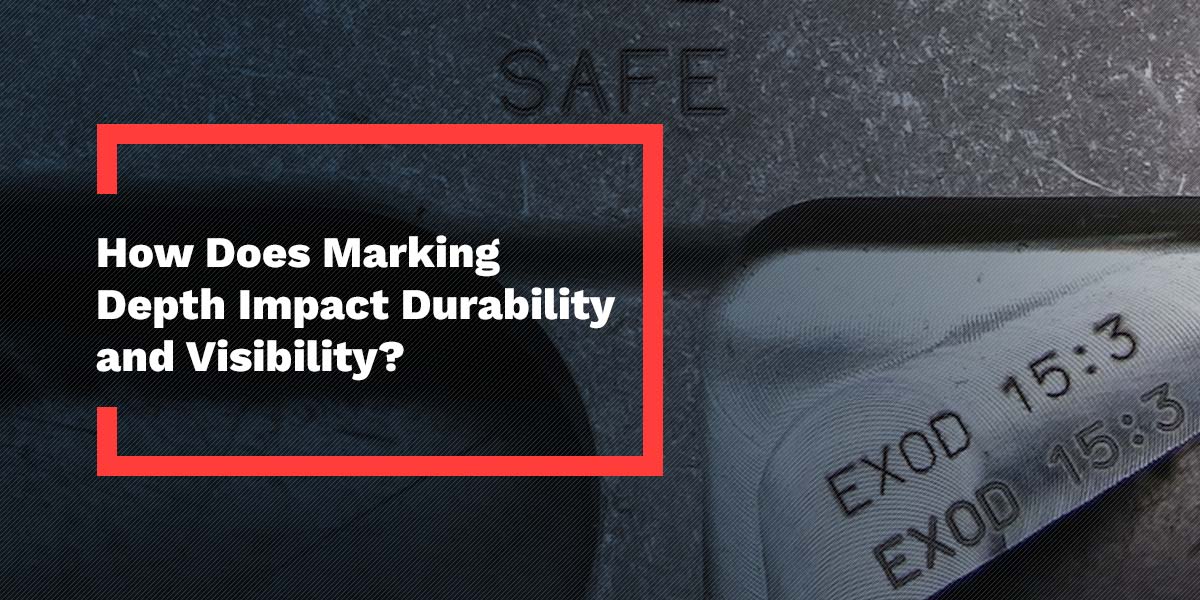
Marking depth impacts durability and visibility by determining how well a mark withstands handling and service conditions.
Shallow marks can lose definition as parts are exposed to environmental conditions. This can affect traceability and inspection accuracy in manufacturing. Excessive material removal can impact stress distribution in mechanically loaded components, compromising surface integrity and product performance.
The challenge for manufacturers is to identify a marking depth that maintains longevity and readability. Achieving consistency across these variables can help operators meet operational requirements.
The Impact of Marking Depth on Durability and Visibility
Engraving depth affects how a part performs throughout its life cycle. Understanding how this factor affects product longevity and legibility can help manufacturers simplify their marking requirements across applications.
Marking Depth Impact on Durability
Deep engraving ensures marks remain legible throughout their life cycle. However, as penetration increases, it creates localized stress that can introduce microcracks. In laser-marked high-strength alloys, excessive depth can modify microstructure through localized heating and recast effects, altering residual stress profiles. These changes can reduce fatigue resistance in load-bearing components and affect long-term stability.
Shallow marks minimize structural impact, but post-processing treatments can obscure engravings. On materials with softer surfaces or thin coatings, shallow engravings may not withstand environmental exposure, undermining traceability reliability.
When trying to maintain laser marking depth, operators must account for material removal and its effect on contrast during finishing or environmental exposure.
Marking Depth Impact on Visibility
Visibility emerges from how a mark interacts with light and imaging systems. Both operator vision and machine-based readers interpret marks through contrasts created by shadowing and surface relief.
Shallow but sharply defined marks can remain visible when their edges produce consistent shadow contrast. Deeper marks with rounded profiles or irregular geometry may scatter light, which might reduce readability.
Uniform depth across characters supports consistent light reflection, which influences barcode grading. As depth variation increases, shadow intensity may vary across the mark, making interpretation dependent on the lighting angle.
Marking Depth and Longevity Across Different Materials
Marking depth also impacts durability and visibility based on material properties. Marking depth that performs well in one material may introduce quality concerns in another.
Hardened Metals
Hardened steels and alloys impose tight constraints on acceptable marking depth because of their sensitivity to surface disruption. While marking processes can enhance resistance to crack initiation, this effect may not offset the structural consequences of material removal.
Deeper engraved marks introduce localized stress concentrations at the edges and base of the cavity. These stress risers become potential initiation sites for fatigue cracks under cyclic loading.
Markings for hardened materials should prioritize controlled, shallow depth combined with high edge definition. Manufacturers can use laser annealing to produce legible contrast. The technique modifies surface oxides rather than removing material, helping them create marks that remain within industry-specific stress limits.
Soft Metals
Soft metals allow deeper marks to form with low laser energy. While this simplifies achieving visibility, it also introduces different longevity considerations. Deeper marks in ductile materials are susceptible to deformation during handling.
Surface treatments further influence depth requirements. For example, anodizing aluminum introduces an oxide layer that can reduce the visible depth if the penetration does not extend below the coating thickness. As such, depth selection in soft metals requires balancing engraving and finishing to preserve surface integrity.
Plastics
Plastics react to marking depth through elastic formation and thermal sensitivity. These materials can exhibit stress whitening or localized deformation when the depth exceeds the material tolerance.
Shallower marks with crisp geometry often provide sufficient visibility in plastics because of inherent contrast differences between marked and unmarked regions. Depth control is also required for thin components to prevent compromising sealing performance or structural integrity.
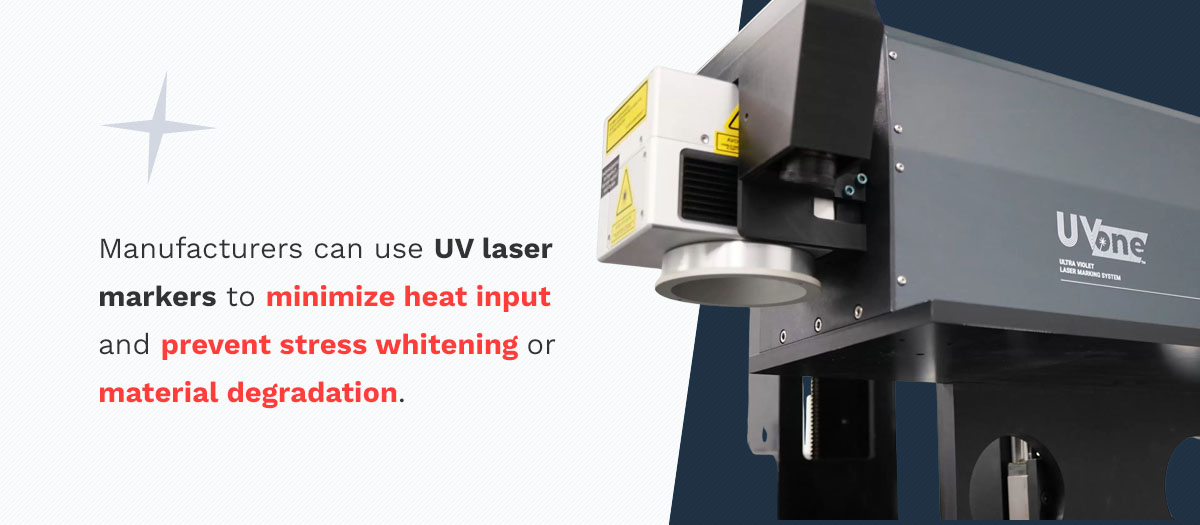
Manufacturers can use UV laser markers to minimize heat input and prevent stress whitening or material degradation. They feature cold marking capabilities for precise, shallow marks with excellent contrast.
The Trade-offs Between Mark Depth, Speed and Quality
Marking depth influences production efficiency in several ways. As depth increases, demands on energy input and process stability rise accordingly.
Here are some trade-offs that can help manufacturers align marking performance with quality objectives:
- Marking depth vs. speed: Faster marking reduces dwell per unit area, which can limit achievable depth, while slower marking allows deeper penetration at the cost of throughput. Marking systems with variable-pulse control allow operators to achieve the desired depth at near-optimal speed. Controlling for depth and speed reduces production bottlenecks while maintaining permanent laser marking durability.
- Marking depth vs. quality: Excessive energy can create heat-affected zones, which reduce legibility. Over-penetration may also distort character geometry. Systems with precise motion control and adaptive marking techniques support repeatable depth even on complex geometries.
Common Depth-Related Issues and How to Correct Them
Depth-related inconsistencies can arise from the marking method and surface conditions. These issues lead to various challenges that trace back to how materials react to marking energy and how systems manage depth across different conditions.
1. Paint Fill-In and Mark Geometry
When a mark is filled with paint or plating materials, it can reduce contrast and legibility. Paint or plating solutions flow into surface recesses, and if the feature width is narrow or the depth is only marginally greater than the coating thickness, the cavities fill. This presents a flat, low-contrast surface once the excess cures.
Corrective measures involve mark geometry. Wider cells in 2D data matrix codes provide larger cross-sectional areas that resist complete fill-in by viscous materials. These geometries create residual relief after coating, preserving contrast. Adjusting pattern design may be more effective than increasing depth, since deeper, narrow marks can still trap coating and remain difficult to read.
In addition, marking systems that produce clean, crisp marks at varying depths can enhance contrast after coatings are applied. Systems that control energy delivery help maintain geometry across a range of coating viscosities.
2. Inconsistent Depth on Curved Surfaces
Curved or contoured parts introduce variation in focal distance for optical systems, which can produce uneven depth. As a result, sections of a mark may appear deeper or shallower, affecting readability.
Solutions involve maintaining consistent energy density or constant contact mechanics across a curved surface. For optical marking, a three-axis laser system with dynamic focusing maintains a consistent spot size and energy at varying distances from the focal plane. This system ensures uniform depth across the mark despite surface curvature.
3. Corrosion Penetration and Surface Integrity
Depth provides durability, but breaches in coating integrity can change electrochemical conditions. This increases corrosion susceptibility under certain conditions.
Manufacturers can prevent corrosion by avoiding material removal where possible and instead using marking methods that modify surface properties without creating deep cavities. Techniques that anneal or oxidize the surface generate contrast by altering reflectivity or surface structure. The result is a visible mark that preserves protective layers.
Where removal-based methods are necessary, subsequent surface treatments can prevent corrosion.
4. Scanner Shadowing
Deep marks create pronounced relief, which produces shadowing under directional lighting. While this can enhance visibility, it may interfere with machine vision systems that depend on uniform lighting around codes. Excessive relief can cast shadows that distort cell geometries, degrading barcode grading.
Addressing this issue involves balancing depth with pattern design and system adaptability. Increasing cell spacing around the code can compensate for shadow penetration, ensuring readings are free of high-contrast gradients that confuse scanners.
Manufacturers can also use marking systems with adaptive power control to tune laser engraving depth and cell output concurrently.
Achieve Optimal Marking Depth and Quality With Telesis Technologies, Inc. Solutions
Telesis Technologies, Inc. helps manufacturers meet their marking needs across various production lines. Our permanent laser marking solutions allow you to achieve consistent visibility and durability. The systems feature Merlin software to ensure precise mark design and quality for unique marking applications.
As a turnkey provider, we offer full integration and ongoing support. Our systems are trusted by NASA, the Department of War and other federal agencies. They also meet industry certifications for medical devices, automotive and other critical applications. XpressMark™ and MOPA laser systems are in stock and ready to ship, and they provide a lower up-front investment.
Fill out a contact form to talk to an expert today.