

12 May Advantages of MOPA Lasers for Industrial Use
Different industrial marking processes require different tools. Standard fiber lasers excel at deep engraving and high-power applications that demand consistent, permanent marks. Master oscillator power amplifier (MOPA) fiber lasers address advanced use cases that need finesse and precise control over the marking process.
MOPA systems feature adjustable pulse parameters that enable manufacturers to achieve high-contrast results on sensitive substrates and create permanent color marks. They also support traceability and part identification.
Understanding mopa laser advantages can help manufacturers maximize efficiency and return on investment (ROI).
1. Unparalleled Control With Adjustable Pulse Duration
MOPA lasers offer adjustable pulse duration, allowing users to tune the pulse width and frequency to control heat input during the marking process. Shorter pulses concentrate energy into briefer intervals, which reduces the thermal load transferred to a material.
This flexibility enables manufacturers to fine-tune heat management to match specific material properties and application requirements. For example, a MOPA system can handle delicate medical housings in one production run and hardened tool steel components in the next.
2. Superior Material Versatility
Direct control over heat input enables marking a wide range of materials without equipment changes. Operators can mark on plastics because the reduced energy delivery prevents heat accumulation that can lead to melting. This capability opens applications in medical device manufacturing, consumer electronics and automotive components where maintaining substrate integrity is essential.
Pulse flexibility also caters to other challenging materials. Anodized aluminum requires precise removal of the protective oxide layer without damaging surrounding areas. Operators can tune MOPA laser pulse parameters to effectively remove coatings and reveal high-contrast marks on the base metal. Stainless steel applications benefit similarly. The adjustable pulse duration produces everything from subtle surface marks to deep engravings on the same material without equipment changes.
3. High-Contrast Marking on Sensitive Surfaces
Pulse control enables marking delicate substrates. Shorter durations concentrate energy into brief intervals, enabling marking on various materials without heat-related defects such as melting or burning.
High-contrast marks on sensitive substrates support identification across regulated industries. For example, medical devices and aerospace components require permanent marks that preserve structural integrity throughout a product’s life cycle. In these applications, manufacturers use a MOPA laser to create legible, traceable parts.
For coated materials with complex layers that respond differently to thermal energy, MOPA lasers can mark through protective coatings or selectively remove layers without affecting underlying substrates.
4. Create Permanent Annealed Color Marks
Adjustable pulse parameters also enable color marking on metals. MOPA lasers can create colors on stainless steel and titanium through controlled oxidation, suitable for permanent marking without inks or pigments.
Parameter-controlled color fidelity allows manufacturers to achieve specific hues for branding, part differentiation or aesthetic requirements. Each color corresponds to specific laser parameters that operators can replicate across production runs. Superior mark permanence makes annealed color marking suitable for parts that undergo chemical exposure or mechanical wear.
5. Enhanced Precision for Traceability
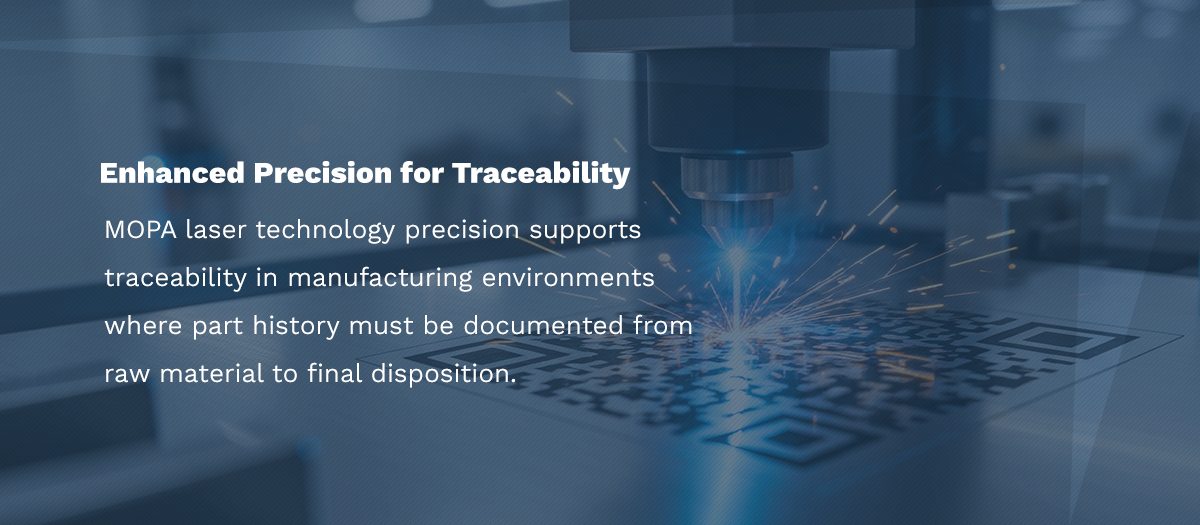
MOPA laser technology precision supports traceability in manufacturing environments where part history must be documented from raw material to final disposition.
For example, medical devices must display unique device identification (UDI) codes that remain scannable after sterilization and years of use. These codes link devices to manufacturing records, allowing targeted recalls. MOPA lasers precisely create intricate marks while maintaining the edge definition required by scanning systems. Clean, high-contrast marks ensure automated systems can reliably scan complex data matrices or QR codes.
Since MOPA systems enable manufacturers to embed identification codes into small components, they integrate seamlessly with robotic automation and Industry 4.0 production environments for advanced production workflows.
6. Cleaner Marks With a Minimal Heat-Affected Zone
MOPA’s pulse precision also minimizes the heat-affected zone (HAZ) — an area where thermal energy alters material properties. Reduced HAZ prevents thermal stress from radiating into the surrounding material, preserving the structural integrity of components.
Minimized HAZ is also valuable for corrosion-resistant alloys. Stainless steel derives its corrosion resistance from a chromium oxide passive layer on the surface. Excessive heat during marking disrupts this protective barrier, compromising material integrity in components exposed to harsh environments. MOPA pulse control minimizes heat input to preserve the passive layer and maintain corrosion resistance in marked areas.
How MOPA Lasers Benefit Long-Term ROI
MOPA laser technical capabilities can create financial value in industrial environments in multiple ways. Consider the following.
Maximize Throughput and Minimize Part Rejection
Higher quality marks and reduced material damage impact production economics in the following ways:
- Optimized production efficiency: Damage-free marking can reduce rework cycles and the need for secondary inspection. Parts that pass initial quality checks can move to subsequent operations, shortening manufacturing cycle times.
- Cost savings from lower rejection: Controlled heat input prevents thermal defects that generate scrap. Each part passing inspection represents preserved material cost and value-added processing. For manufacturers processing diverse substrates, consistency across materials can result in savings.
- Increased operational throughput: When marking operations accommodate varied materials without delays from parameter optimization or equipment changes, production lines maintain continuous flow. A single MOPA system marking housings and hardened steel in consecutive runs can reduce changeover bottlenecks.
- Stronger financial returns: The compounding effect of reduced scrap and increased throughput improves return on investment. As marking quality improves, the cost per compliant part may decrease as production volumes increase.
Expand Your Service Offerings and Take on New Projects
MOPA lasers’ versatility supports operational growth through:
- Access to premium markets: Regulated industries such as aerospace and defense require permanent codes that survive harsh environments. MOPA’s micro-marking precision and minimal HAZ help manufacturers meet the stringent traceability and part-integrity standards these sectors require.
- Attract high-value projects: Capabilities such as annealed color marking on metals and high-contrast marking on coated surfaces create a technical advantage that can open the door to high-value projects. This differentiation supports premium pricing because customers may value capabilities that expand design possibilities.
- Competitive market differentiation: Medical device manufacturers and precision instrument producers require damage-free marking on sensitive substrates and permanent codes on small components. MOPA laser marking competency in these areas differentiates manufacturers in competitive bidding processes.
Partner With Telesis Technologies, Inc. for MOPA Fiber Laser Solutions
Telesis Technologies, Inc. is a one-stop shop for industrial permanent marking solutions. When you work with us, you are not purchasing equipment — you are building a relationship with a strategic marking partner. Our XpressMark MOPA™ — which features Merlin® software — provides reliability, easy setup and seamless integration with a lower up front investment. The solution is in stock and ready to ship.
We are a tier 1 automotive manufacturing partner, and our American-made systems are trusted by NASA, the Department of War and other federal agencies. Our team provides technical training, customization and comes to you for any product fixes.
With worldwide sales and support, in-house integration capabilities and certifications for medical device and automotive manufacturing, we deliver comprehensive solutions that fit your production requirements.
Fill out a contact form to talk to an expert today.