
14 Apr MOPA Laser Cost Factors
A high-performance MOPA laser marker is a capital investment. It offers operational efficiency, seamless integration and production capabilities that support competitive positioning. The MOPA pulsed fiber laser market is projected to grow at a 7.5% CAGR by 2034, driven by adoption across industrial manufacturing.
Manufacturers seeking an operation-specific solution benefit from understanding which factors drive long-term value. Power specifications, component quality, software capabilities and advanced features each influence performance, and their impact varies based on production environments.
This MOPA laser cost breakdown examines the factors that determine a system’s value.
1. Laser Power Wattage
Power wattage determines how efficiently a system marks and how deeply it engraves. Higher-wattage systems deliver faster marking speeds and deeper engraving for high-volume production environments. For instance, a 100-watt (W) system can complete marks in a fraction of the time required by lower-power alternatives, producing more parts processed per shift and greater throughput.
Lower-wattage options excel when fine detail takes priority over speed. A 30 W system provides exceptional precision for intricate logos and complex graphics on sensitive materials. The value proposition depends on operational requirements. Volume-focused operations benefit from higher-wattage speed, while detail-oriented applications gain more from lower-wattage control.
Leading manufacturers offer MOPA lasers across power options, including 30 W, 60 W and 100 W configurations. This flexibility allows operators to match system capabilities to specific marking requirements without overinvesting in unusable power or underinvesting in the speed of production demands.
2. The Quality and Brand of the Laser Source
The laser source’s reliability determines long-term operational value. High-quality MOPA laser systems deliver consistent performance across several marking cycles. They maintain beam quality, output stability and marking consistency throughout their service life.
Expert manufacturers prioritize durability in industrial environments by selecting components that maintain system performance under continuous operation. When evaluating a MOPA laser price, recognize that the initial investment reflects engineering and manufacturing capabilities for reliable performance throughout a solution’s life.
3. Software Capabilities and Automation Readiness
Systems integrated with user-friendly software simplify mark design and execution. They feature intuitive interfaces that allow operators to create complex marking patterns and adjust parameters, helping reduce the risk of programming errors that lead to rework.
A system’s ability to integrate with automated production lines adds further value. Automation-ready systems seamlessly communicate with robots and conveyor systems to improve mark-placement accuracy across production runs.
Integrated software solutions combine marking control and file management in a single interface that connects a marking system to an entire manufacturing execution system. This integration extends the value of your hardware investment across your entire operation.
4. Advanced System Features and Configuration
Specialized hardware features contribute to system efficiency and precision. Systems with autofocus technology adjust focal length automatically as part geometry changes. This capability reduces setup time and ensures consistent mark quality across complex surfaces and varying part heights.
Some systems feature variable z-axis systems to accommodate parts with varying heights. The technology automatically adjusts the working distance to maintain optimal focus throughout the marking process. They also feature integrated in-line vision capabilities to enhance marking accuracy and reading codes for quality confirmation. Advanced features can improve first-pass yield across the production environment.
How to Evaluate MOPA Laser ROI
A comprehensive budget analysis includes long-term operational costs and the tangible returns a system generates. Your return on investment (ROI) calculation should account for direct cost reductions and the value of enhanced capabilities.
1. Evaluate the Total Cost of Ownership
Additional costs may arise after the initial purchase, and understanding these expenses helps manufacturers budget accurately. Considerations when buying a MOPA laser include:
- Installation: Professional installation and startup services ensure that the system integrates seamlessly with existing production equipment and operates reliably at specified performance levels.
- Integration with existing systems: Connecting a marking system to automated and quality systems requires engineering expertise and compatible communication protocols. Seamless integration enables real-time data exchange and supports manufacturing capabilities.
- Operator training: Comprehensive training programs help teams maximize system capabilities while reducing programming errors. Well-trained operators extract more value from advanced features and identify potential issues before they impact production.
While investing in a robust system streamlines operations, partnering with a turnkey provider can help maximize ROI through:
- In-house service: Access to a provider who understands specific system configuration minimizes integration troubleshooting and ensures training aligns with a production environment.
- Customization capabilities: Engineering resources that handle hardware adaptation and automation integration reduce the complexity of coordinating between equipment suppliers and third-party integrators. Custom solutions address unique production requirements while maintaining system warranty and support.
- Technical support: Ongoing assistance ensures the training teams receive remains relevant as production needs evolve, and installation best practices continue to deliver value as operations scale. This continuity prevents knowledge gaps that emerge when working with multiple disconnected vendors.
2. Assess the Performance and Production Value
MOPA lasers’ adjustable pulse control enables a system to work across a range of materials. This versatility means a single system handles multiple marking applications, improving production flexibility.
Faster cycle times impact production capacity and throughput. A system that reduces marking time can produce more parts per shift with the same labor and overhead costs. Higher-contrast results reduce rejection rates by ensuring marks meet readability standards for inspectors and automated verification systems.
3. Project the Return on Investment
A ROI calculation accounts for the financial impact of improved capabilities and reduced waste. Consider:
- Increased production speed: Calculate the value of additional parts produced per shift based on reduced cycle times and improved uptime. When a marking system processes parts faster, the same production schedule may yield higher output without extended operating hours. Increased throughput can improve revenue per unit of capacity.
- Reduced material waste: Estimate savings from fewer rejected parts because of better mark quality and improved process control. Higher first-pass yield rates reduce scrap costs and the expense of rework cycles that affect material and production capacity.
- Ability to offer new services: Quantify revenue opportunities from marking applications, such as color marking on metals or fine detail on medical devices. System versatility opens new market segments and allows manufacturers to take on higher-value projects that expand service portfolio and improve profit margins.
- Meeting industry compliance standards: Factor in the costs of compliance failure and quality issues in regulated industries. For instance, the U.S. Food and Drug (FDA) regulations require direct part marking on reusable medical devices for unique device identification (UDI) tracking. Systems that meet these standards protect market access and prevent costly regulatory violations that can halt production.
Experience the Difference of a MOPA Laser Investment
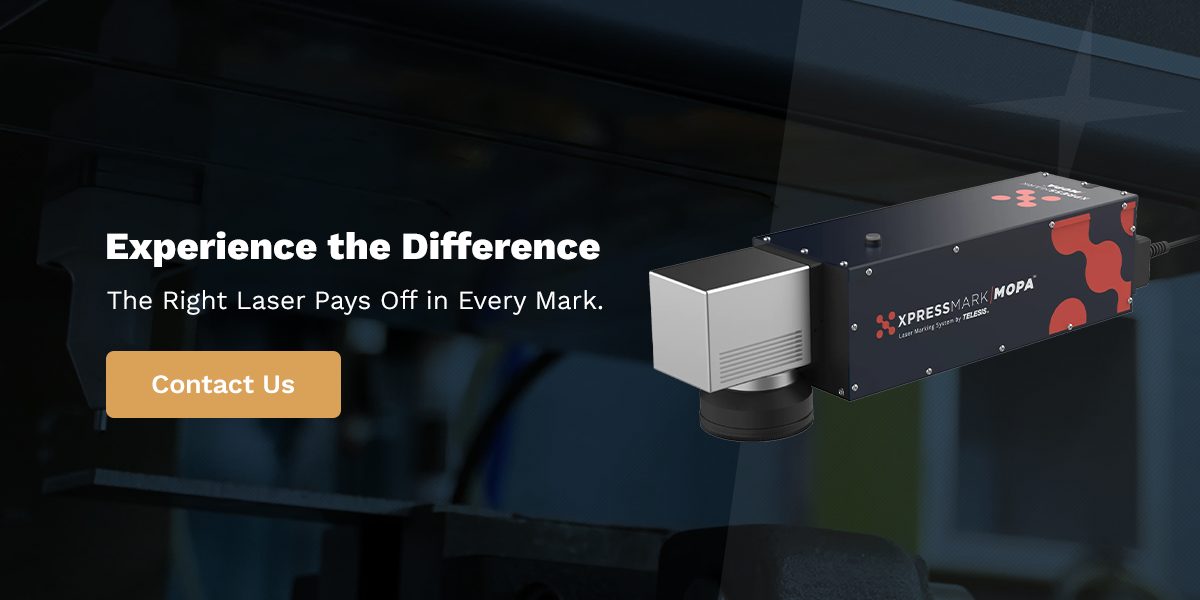
When buying a MOPA laser, you are not purchasing equipment — you are building a partnership with a strategic marking provider. Telesis Technologies, Inc. is a one-stop shop for industrial permanent marking solutions. We are your turnkey provider, delivering the XpressMark MOPA™ — which features Merlin® software — with a lower up-front investment. Our systems are in stock now and ready to ship.
We are a tier 1 automotive manufacturing partner, and our American-made solutions are trusted by NASA, the Department of War and other federal agencies. Our team offers custom-engineered solutions that integrate with preexisting production lines. They also provide technical support and come to you for any product fixes.
With worldwide sales and support, and certifications for medical device and automotive manufacturing, we provide the expertise your investment demands.
Fill out a contact form to talk to an expert today.