
24 Nov What Is Cold Laser Marking?
Manufacturers face increasing pressure to mark parts with precision while protecting the integrity of delicate materials. Even minimal heat exposure can distort fine components or compromise compliance with quality standards. These challenges leave engineers seeking a marking process that can deliver durability and accuracy on sensitive substrates.
Cold laser marking creates crisp, permanent identifiers that preserve the structure and appearance of delicate components and meet demanding traceability and performance requirements.
Discover what cold laser marking is, its benefits and industrial applications.
Understanding Cold Laser Marking
Cold laser marking is a high-precision, noncontact process that uses controlled energy to mark a material’s surface. It uses short laser wavelengths and pulse durations to trigger localized photochemical reactions. These reactions alter a material’s microstructure or surface composition, producing a clean, permanent mark. Because there’s virtually no heat transfer beyond the target point, the process preserves a substrate’s mechanical and aesthetic properties.
Cold marking is suited for delicate or heat-sensitive substrates, including:
- Metals: Cold laser marking performs exceptionally well on metals that require dimensional stability and surface consistency. It leaves crisp, high-contrast marks on stainless steel, titanium and other alloys.
- Plastics: The process enables permanent, precise marking on various types of plastic while preserving their structural integrity. This capability supports industries that produce products requiring clean marks on smooth or lightly textured surfaces.
- Paper and cardboard: Cold marking systems can produce sharp, high-contrast text or codes on packaging materials. Its precision makes it practical for marking barcodes or logos on coated paper and security-grade products.
- Glass: Cold marking enables detailed, permanent marking on clear or frosted glass surfaces. The laser’s short wavelength helps create a fine effect that enhances contrast.
- Ceramics: The marking process subtly modifies the surface structure of technical ceramics at a microscopic level, which produces high-definition marks with stable contrast.
- Foils and films: Metallic foils, polymer films and coated laminates are extremely sensitive to heat. Cold laser marking can process these substrates with exceptional control.
How Cold Laser Marking Works
Cold laser marking operates through precise, controlled interactions between laser energy and the substrate. The process uses the inherent properties of short-wavelength light and ultrashort pulse durations to achieve permanent and minimally invasive marks. The mechanisms that enable cold markings are:
- Shorter wavelength: Short-wavelength lasers carry high photon energy. This wavelength allows for smaller spot sizes, which create sharper, more precise marks.
- Photochemical reaction: Cold laser marking induces photochemical changes at the molecular level. High-energy photons break chemical bonds in the surface layer, creating color changes or localized microstructural alterations that turn into permanent marks.
- Minimized heat-affected zone: The laser confines the energy to one surface area, helping prevent warping, cracking or microstress formation.
Benefits of Cold Marking
Cold laser marking’s combination of precision and durability helps support quality, regulatory compliance and product longevity.
1. Preserves Material Integrity
Cold laser marking maintains a substrate’s inherent physical and chemical properties. The process operates with minimal thermal input, ensuring that metals preserve their tensile strength while plastics retain their shape and surface texture. Coated or anodized surfaces remain intact, free from discoloration or microfracturing.
2. Achieves High Precision and Detail
Cold laser marking delivers an exceptional level of precision that meets the requirements of manufacturing. The use of short-wavelength lasers and short pulses produces defined marks, enabling the creation of detailed serial numbers and complex codes with consistent clarity.
This precision ensures that every mark is reproducible and legible. The process produces edges with remarkable sharpness and contrast by confining energy to the surface layer.
3. Offers Material Versatility
Cold laser marking’s adaptability across diverse materials and part geometries makes it a versatile solution for manufacturing. It can accommodate flat or complex three-dimensional surfaces. The process requires minimal adjustments when switching between substrates, so manufacturers can maintain a consistent marking approach across multiple product lines.
Applications of Cold Laser Marking
Cold marking is used across various industries to help preserve material integrity. Its ability to produce high-resolution, durable marks makes it a vital tool for manufacturers seeking quality assurance.
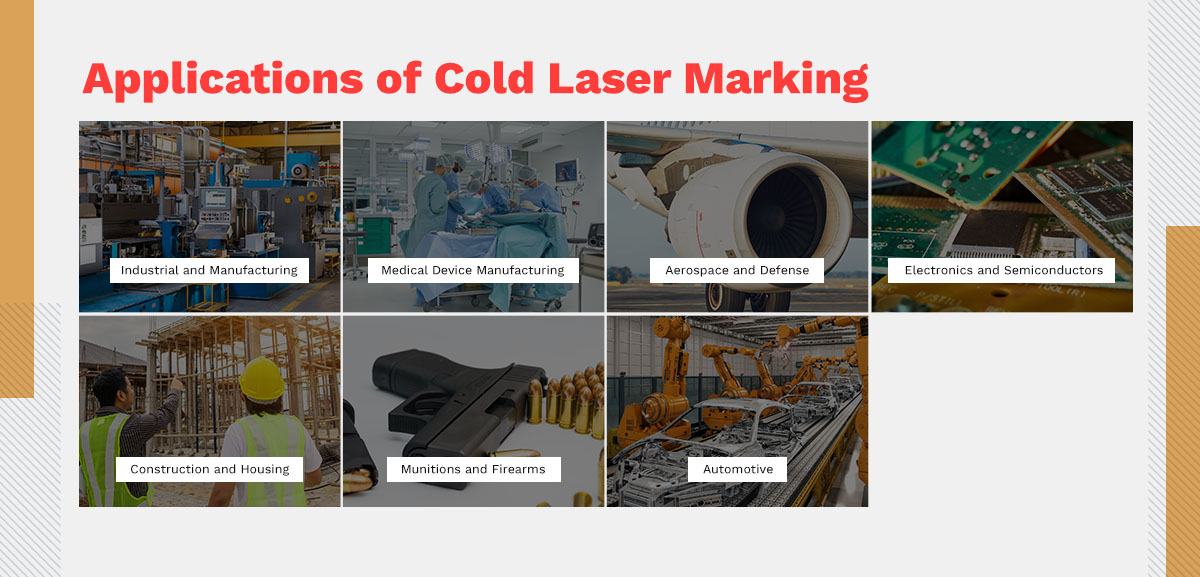
Industrial and Manufacturing
Cold laser marking is crucial for industrial and manufacturing environments because it helps with part identification, traceability and quality control. It enables permanent, high-contrast marks on machine components and fabricated assemblies.
Manufacturers can implement serial numbers, batch codes or logos on various substrates. This capability ensures that products maintain performance standards and traceability throughout production and assembly.
Medical Device Manufacturing
In medical device production, cold laser marking ensures marks that withstand sterilization and handling. It allows clear and permanent identification on surgical instruments and medical assemblies, which supports compliance with regulatory standards. The process accommodates materials commonly used in medical devices, maintaining surface finish and marks that are reliable and legible.
Aerospace and Defense
Aerospace and defense components require durability and traceability in extreme conditions. Cold marking provides permanent identification on high-value alloys and composite materials. The process supports complex geometries and heat-sensitive coatings, allowing detailed serial numbers and tracking marks that remain intact under high stress and vibration.
Electronics and Semiconductors
The electronics and semiconductor industries require marks that do not interfere with heat-sensitive substrates. Cold laser marking enables precise identification on printed circuit boards (PCBs) and protective films. High-resolution marks and data matrix codes can be applied to compact or intricate assemblies, providing support for traceability and anti-counterfeiting measures.
Construction and Housing
In the construction and building materials industry, cold laser marking can be applied to coated metals and other structural components to create part numbers or branding marks. The precision and permanence of these marks ensure traceability throughout every product’s life cycle.
Munitions and Firearms
For munitions and firearms, cold laser marking delivers precise identification on critical components. Marks on barrels and other metallic parts remain legible despite exposure to heat or environmental factors. The process preserves material strength and surface finish while providing permanent traceability.
Automotive
In the automotive industry, cold laser marking allows manufacturers to apply clear, permanent identifiers on:
- Electronic assemblies
- Sensitive foils and components
The marks withstand harsh operating conditions, including temperature cycling and chemical exposure. This capability ensures traceability and compliance with industry standards.
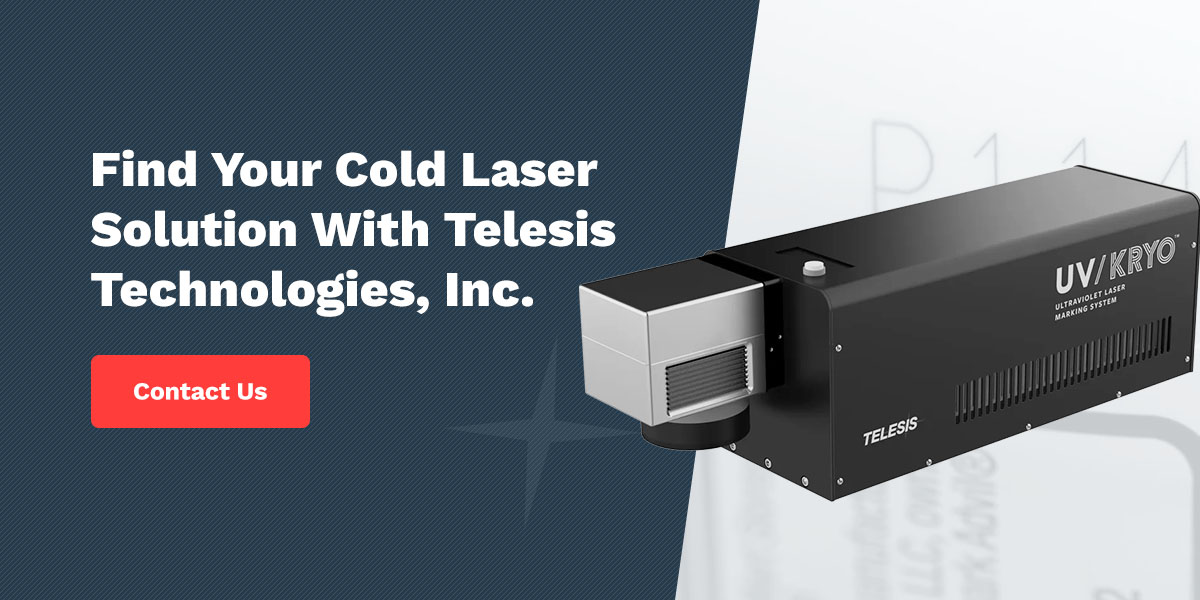
Find Your Cold Laser Solution With Telesis Technologies, Inc.
Telesis Technologies, Inc. provides turnkey marking solutions tailored to meet your requirements. Our KRYO laser produces high-contrast results on a wide range of materials. We combine advanced laser technology with Merlin® software to give you full control over mark design and automation through an intuitive platform. Every system we deliver includes integration and dedicated support.
Our marking systems are trusted across industries and are used by NASA, the Department of War and other global leaders who rely on mission-critical equipment. Built by a team that includes United States veterans, our systems reflect a commitment to precision and service. We hold certifications across regulated industries, maintain confidentiality when required and offer global sales, in-house engineering and field support for complete customer confidence.
Fill out a contact form today to talk with an expert.