
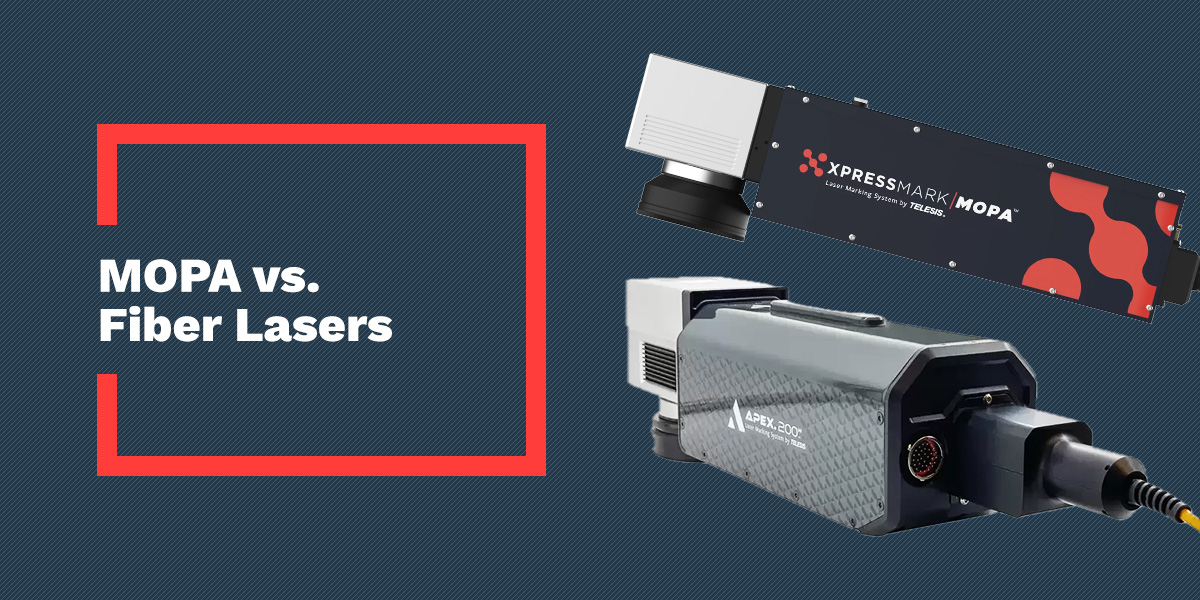
12 Dec MOPA vs. Fiber Lasers
Laser marking is a critical process in manufacturing. It supports traceability, compliance and branding across industries. As production requirements evolve, manufacturers may encounter requirements that call for marks that remain legible under harsh conditions, adapt to different materials and meet strict quality standards.
Choosing the right laser system can help meet these demands. Fiber and master oscillator power amplifier (MOPA) lasers both use fiber-based technology, but they differ in how they generate and control laser pulses. Those differences affect mark appearance, material compatibility and production speed.
Discover what MOPA vs. fiber lasers are, their differences and how to select the right one for your needs.
What Is a Fiber Laser?
A fiber laser is a type of laser in which the laser beam is generated and amplified using an optical fiber doped with ytterbium — a rare-earth element. This configuration enables highly efficient light amplification and an extremely stable beam output.
In industrial marking and engraving, the most established and widely used configuration is the Q-switched fiber laser. This technology uses a Q-switch to generate short, high-energy pulses, typically in the nanosecond range, allowing for fast, permanent and high-contrast marks on metals and other hard materials. A fiber laser delivers consistent results over extended production runs, thereby optimizing throughput and uptime.
Fiber laser use cases include:
- Deep engraving and permanent metal marking
- Serial number and barcodes
- Unique identifier (UID) codes
- Aerospace and defense part identification
- Automotive components requiring traceability
- Electronic devices with metal housings
What Is a MOPA Laser?
A MOPA laser is a type of fiber laser that builds upon the same principle as a fiber laser with an additional level of control. The master oscillator generates the laser signal, while the power amplifier boosts its energy before it exits the system.
A MOPA laser features an adjustable pulse duration. Operators can control the amount of heat delivered to the material’s surface by tuning the pulse width and frequency. This fine-tuning ability makes MOPA lasers versatile across a wide range of materials and applications.
MOPA technology is ideal for marking heat-sensitive substrates or for controlling the visual characteristics of a mark.
Typical MOPA laser applications include:
- Color marking on stainless steel
- High contrast marking on plastics and polymers
- Fine engraving on anodized aluminum
- Visual finesse for branding applications
What Is the Difference Between MOPA Lasers and Fiber Lasers?
While both lasers are fiber-based systems, their operational strengths align with different industrial needs. Below is a comparison of MOPA vs. fiber lasers to help you match the right technology to your production needs.
Deep Engraving and Metal Marking
Fiber lasers are ideal for manufacturers seeking to create deep, permanent marks on metals. The high peak power generated by fiber lasers allows for rapid energy delivery to a material surface. This energy creates in-depth engravings to create visually sharp and legible marks. The high pulse intensity is ideal for high-volume production settings because fiber lasers produce concentrated energy that produces uniform, high-contrast marks on stainless steel, aluminum or titanium.
The MOPA laser also achieves impressive results in metal marking. It allows operators to influence surface oxidation, contrast and texture by adjusting pulse duration and frequency. This capability makes MOPA the go-to solution for aesthetic control and subtle detailing. The MOPA laser has the ability to also achieve very deep marks even on the toughest metal.
Color Marking on Stainless Steel
Color marking is achieved through precise thermal oxidation, which requires meticulous control over the heat delivered to the surface. MOPA lasers enable operators to adjust pulse duration and frequency, thereby controlling temperature at a microsecond scale. This precision creates consistent color effects, ranging from gold to blue, while maintaining the surface’s structural integrity.
Applications for this capability include:
- Branded metal products
- Medical instruments
- Cutlery
- Decorative hardware
Fiber lasers excel at delivering dark, high-contrast annealed marks consistently. For applications that require clear identification on robust surfaces, fiber lasers reliably produce uniform results.
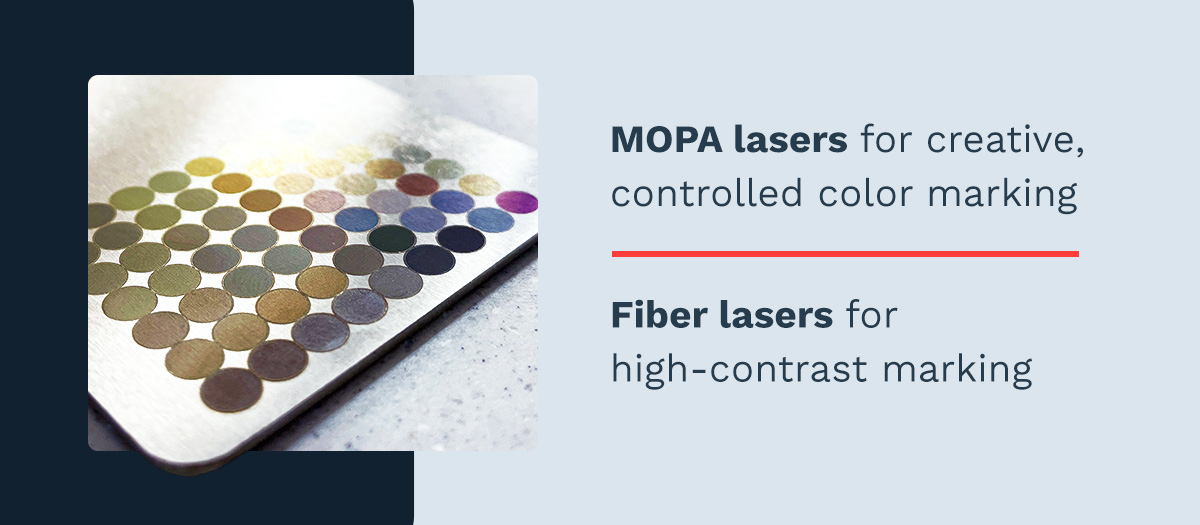
The two technologies may complement one another. Operators can use MOPA lasers for creative, controlled color marking and fiber lasers for high-contrast marking.
Marking on Plastic and Polymers
Working with plastics and polymers requires precise control over heat management. Excessive energy can deform or discolor sensitive materials, so the ability to fine-tune the laser’s output is essential. MOPA lasers provide this flexibility by adjusting pulse width and frequency, enabling operators to create clean, high-contrast marks. These precision and material preservation capabilities are ideal for:
- Electronics housing
- Medical device components
- Automotive interiors
Fiber lasers are effective on polymers that can tolerate greater energy input. They provide a more aggressive engraving approach that may produce permanent and wear-resistant marks.
Manufacturers can opt for fiber lasers when creating marks required to withstand mechanical stress or environmental exposure, and choose MOPA for applications that preserve material surfaces and maintain visual clarity.
Marking on Anodized Aluminum
Anodized aluminum is a common substrate in industrial, consumer and decorative applications because of its protective oxide layer. Marking choices differ depending on the desired visual outcome.
MOPA lasers produce brilliant white and rich black marks by modulating pulse energy and duration. This level of control allows for nuanced finishes, grayscale effects and optimized contrast. Typical applications include:
- Branding
- High-end electronics
- Precision instruments
Fiber lasers offer highly effective ablation marking by cleanly removing the anodized layer to expose the underlying metal. This precision produces consistent white marks with strong contrast, making fiber lasers an ideal choice for serialization and traceability.
How to Select the Right Laser System
Selecting between an MOPA vs. a fiber laser depends on aligning each system’s capabilities with your production needs. Fiber lasers are well-suited for high-speed metal marking because they cater to high-throughput applications. Operators typically use them in the aerospace and automotive industries to create uniform marks across large volumes.
MOPA lasers offer adjustable precision, making them suitable for applications involving delicate materials and processes that require specific finishes or color marking.
Manufacturers can use both systems to handle various marking requirements. Fiber lasers can support faster, higher-volume marking tasks, while MOPA systems can be used for precise control over a mark’s visual quality and to regulate thermal impact.
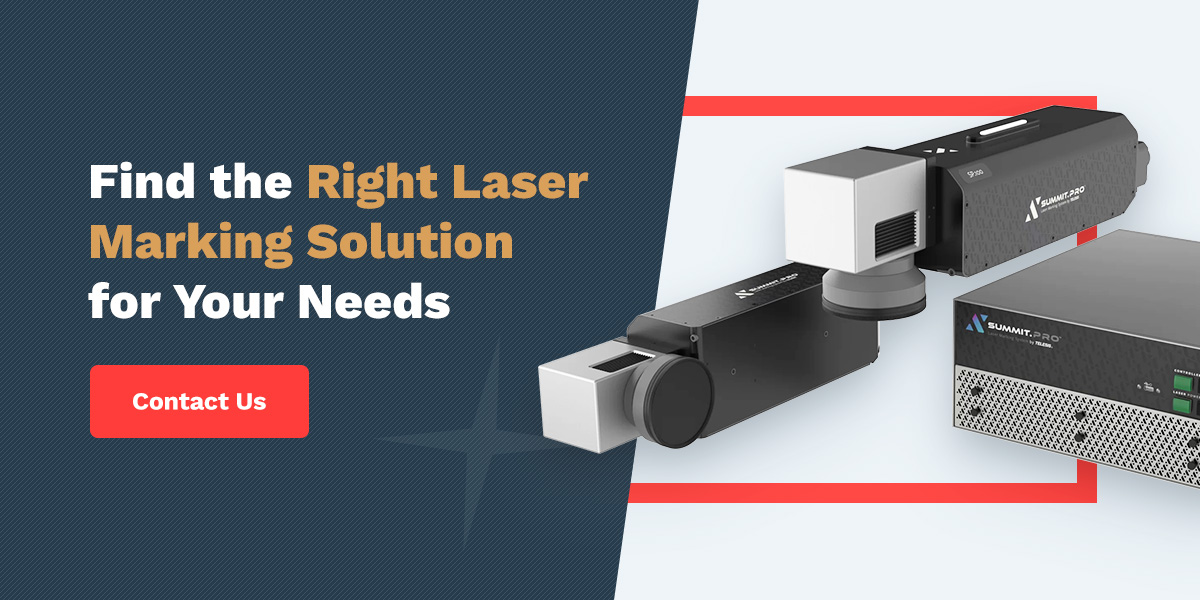
Find the Right Laser Marking Solution for Your Needs
Telesis Technologies, Inc. delivers comprehensive laser marking solutions tailored to your production needs. We handle everything in-house, including system design, integration, service and global support. Our MOPA and fiber laser systems provide consistency, durability and precision across every application.
Our Merlin® software provides you with full control over marking parameters, automation and traceability, while our engineering team ensures that the system integrates into your workflow. Various organizations, including the National Aeronautics and Space Administration (NASA), the U.S. Department of War and leading manufacturers, trust our systems.
Contact us today to speak with one of our experts.